
Channel letters are everywhere — on every strip mall, restaurant, gym, and office building in America — yet almost nobody outside the trade knows how they're actually made. Understanding the construction helps business owners ask sharper questions and helps salespeople explain why quality matters at these price points.
For the wider process, see how signs are made; for what a set costs, see how much channel letter signs cost.
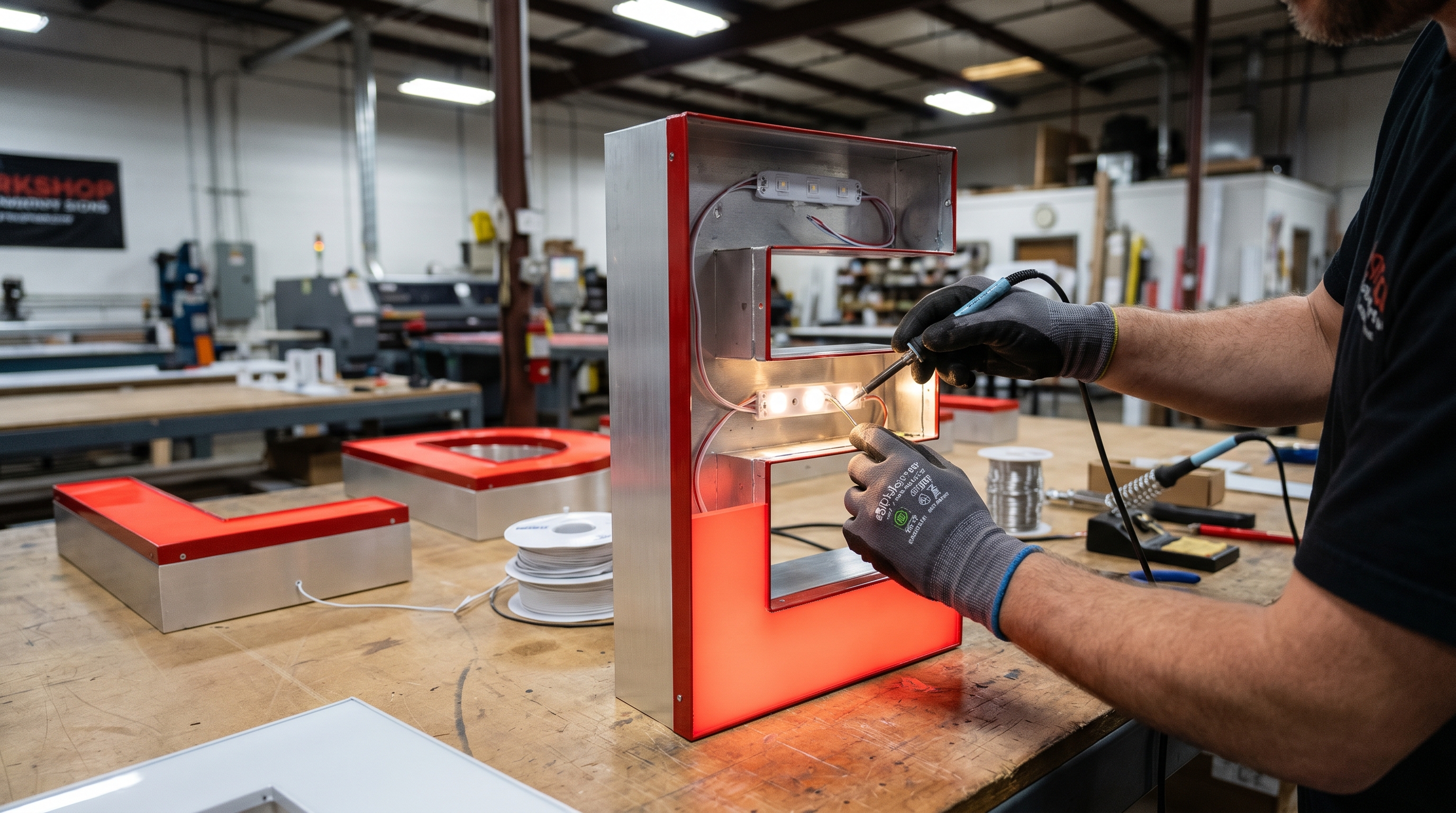
The Four Components
| Component | What it is | Detail that matters |
|---|---|---|
| Return | The bent aluminum sidewall giving depth | 0.040"–0.063" coil; standard 3", 4", or 5" depth |
| Face | The front surface | ~3mm translucent acrylic (front-lit) or opaque metal (halo) |
| LED modules | The light source inside | Quality modules rated 50,000+ hours (~17 yrs at 8 hr/day) |
| Power supply | Driver converting AC to low-voltage DC | Undersizing it is the #1 cause of premature failure |
The Fabrication Process
Step one is bending the aluminum coil to the letter profile. CNC letter benders (Metalix, Pro-Line, AXYZ) take a digital letter file and bend the return automatically with high precision; manual bending is still used for custom or low-volume work but is slower and demands experienced hands for consistent curves.
The return is corner-joined (welds or mechanical fasteners at inside corners), cleaned, primed, and painted to the specified Pantone or brand color. The face is routed or laser-cut to the exact shape and attached to the return perimeter with trim cap. LEDs are installed, wired to a properly sized power supply, and tested before mounting — because finding a dead module after installation means going back up the wall.
Front-Lit vs Halo-Lit vs Open Face
Front-lit (standard): light shines forward through the translucent acrylic face. The most common type — bright, readable at distance, and the most economical. The face color sets the sign color.
Halo-lit (reverse channel): the face is opaque (often brushed metal), with LEDs on the back pointing at the wall. Light escapes around the perimeter for a glowing halo. More expensive to build, and it needs a light-colored, reflective wall to show — a premium look for upscale retail and hospitality.
Open face: traditional glass neon bent to the letter shape inside an open channel. Increasingly rare due to maintenance cost and fragility — specialty applications only.
You can't see the power supply from the sidewalk — which is exactly why the cheap sign cuts it there first.
What Determines Lifespan
A quality set should last 10–15 years with minimal maintenance. What shortens it:
- Undersized power supplies that run hot and fail early — the most common failure point.
- Poor weather seals at the face-to-return joint, letting water intrude.
- Low-quality LED modules that dim noticeably before their rated 50,000 hours.
- Inadequate primer or paint, allowing corrosion on the aluminum return.
Signs built with quality components and proper finishing routinely outlast their environment — the building gets re-tenanted and the sign comes down while still fully functional. That longevity is the real argument for paying for a properly built set; the math behind it is in channel letter pricing.